Nature of Science and Control of Variables Strategy: Connections and Educational Applications
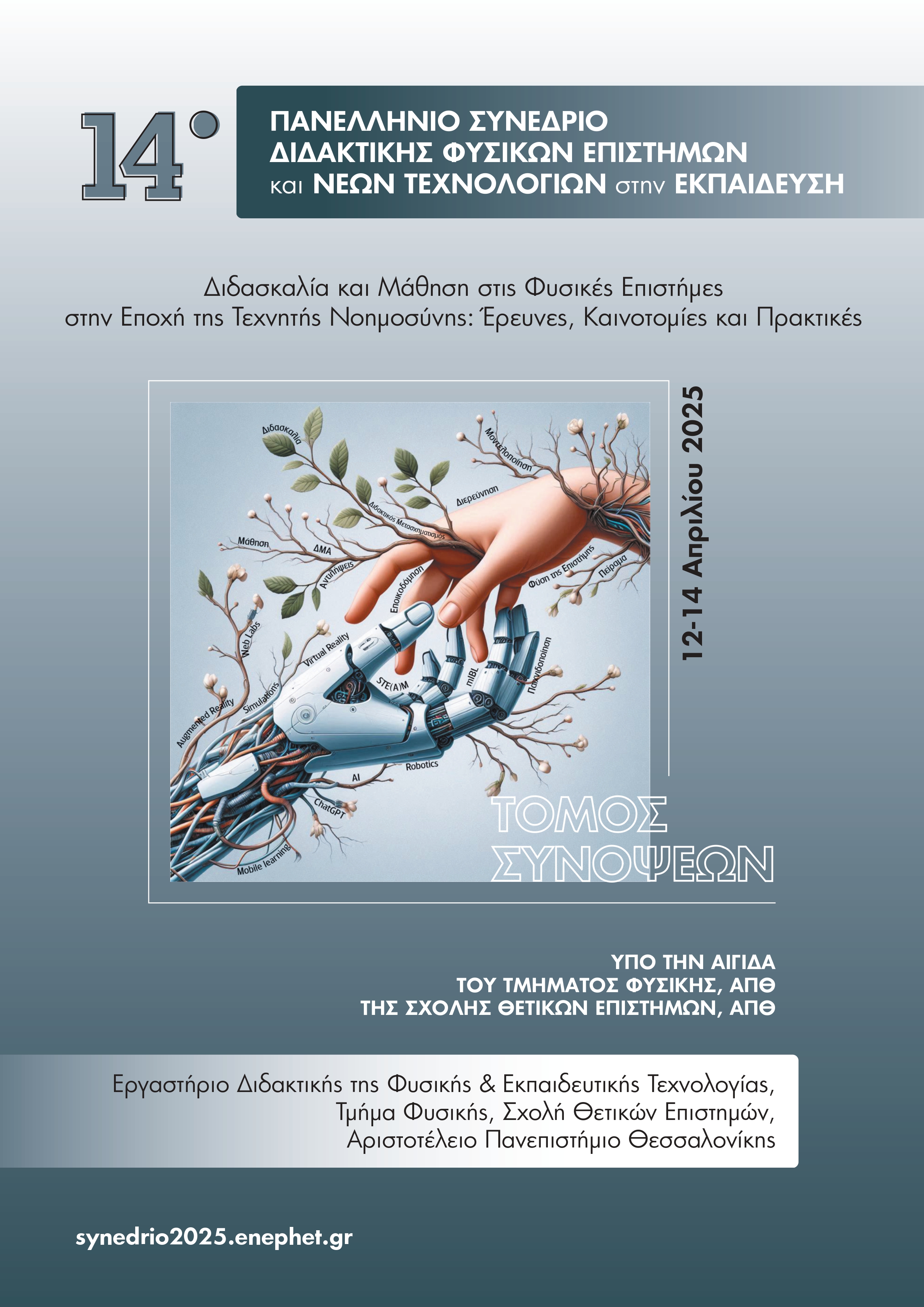
Published:
Apr 7, 2025
Keywords:
Nature of Science, Nature of Scientific Inquiry, Control of Variables Strategy, Inquiry-Based Learning
Abstract
The study explores the relationship between epistemological knowledge (Nature of Science – NOS, Nature of Scientific Inquiry – NOSI) and the development of control of variables strategy (CVS) skills through four-month Hands-On inquiry-based activities with high school students. The findings showed statistically significant improvements in epistemological knowledge and skills, as well as correlations between them. The study highlights the importance of inquiry-based learning for developing epistemological beliefs and inquiry skills in science education.
Article Details
- Section
- 14th Panhellenic Conference of Didactics in Science Education
Downloads
Download data is not yet available.
References
Γκάγκας, Β., & Χατζηκρανιώτης, Ε. (2022). Επιστημολογικές πτυχές της Φύσης της Επιστήμης και της Φύσης της Επιστημονικής Διερεύνησης, προς διδασκαλία σε μαθητές/τριες της δευτεροβάθμιας εκπαίδευσης στο μάθημα της Φυσικής: 4o Πανελλήνιο Συνέδριο Νέων Ερευνητών και Ερευνητριών, 16–18 Σεπτεμβρίου 2022. Αλεξανδρούπολη. https://doi.org/10.12681/nrcodiste.5966
Alake-Tuenter, E., Biemans, H. J., Tobi, H., Wals, A. E., Oosterheert, I., & Mulder, M. (2012). Inquiry-based science education competencies of primary school teachers: A literature study and critical review of the American National Science Education Standards. International Journal of Science Education, 34(17), 2609–2640. http://dx.doi.org/10.1080/09500693.2012.669076
Banchi, H., & Bell, R.L. (2008). The many levels of inquiry. Science and Children, 46(2), 26-29. Ανακτήθηκε στις 17/3/2022, από https://api.semanticscholar.org/CorpusID:150760967
Chen, Z., & Klahr, D. (1999). All other things being equal: Acquisition and transfer of the control of variables strategy. Child development, 70(5), 1098–1120. https://doi.org/10.1111/1467-8624.00081
Kremer, K., Specht, C., Urhahne, D., & Mayer, J. (2014). The relationship in biology between the nature of science and scientific inquiry. Journal of Biological Education, 48(1), 1–8. https://doi.org/10.1080/00219266.2013.788541
Lederman, N.G., Abd-El-Khalick, F., Bell, R.L., & Schwartz, R.S. (2002). Views of nature of science questionnaire: Toward valid and meaningful assessment of learners’ conceptions of nature of science. Journal of Research in Science Teaching, 39(6), 497–521. https://doi.org/10.1002/tea.10034
Lin, H.-S., & Chiu, H.-L. (2004). Student understanding of the nature of science and their problem-solving strategies. International Journal of Science Education, 26(1), 101–112. https://doi.org/10.1080/0950069032000070289
Petridou, E., Molohidis, A., & Hatzikraniotis, E. (2022). Assessing students’ ability to apply the control of variables strategy when engaged with inquiry-based worksheets during the COVID era. Education Sciences, 12(10), 668. https://doi.org/10.3390/educsci12100668
Priemer, B., & Lederman, N. G. (2021). Nature of scientific knowledge and nature of scientific inquiry in physics lessons. Στο H. E. Fischer & R. Girwidz (Επιμ.), Physics education: Challenges in physics education (σελ. 113–150). Springer. https://doi.org/10.1007/978-3-030-87391-2_5
Savery, J. R. (2015). Overview of problem-based learning: Definitions and distinctions. Στο A. E. Walker, H. Leary, C. E. Hmelo-Silver, & P. A. Ertmer (Επιμ.), Essential readings in problem-based learning: Exploring and extending the legacy of Howard S. Barrows (σελ. 5–15). Purdue University Press.
Schwichow, M., Christoph, S., Boone,W. J., & Härtig, H. (2016). The impact of sub-skills and item content on students’ skills with regard to the control-of-variables strategy. International Journal of Science Education, 38(2), 216–237. https://doi.org/10.1080/09500693.2015.1137651