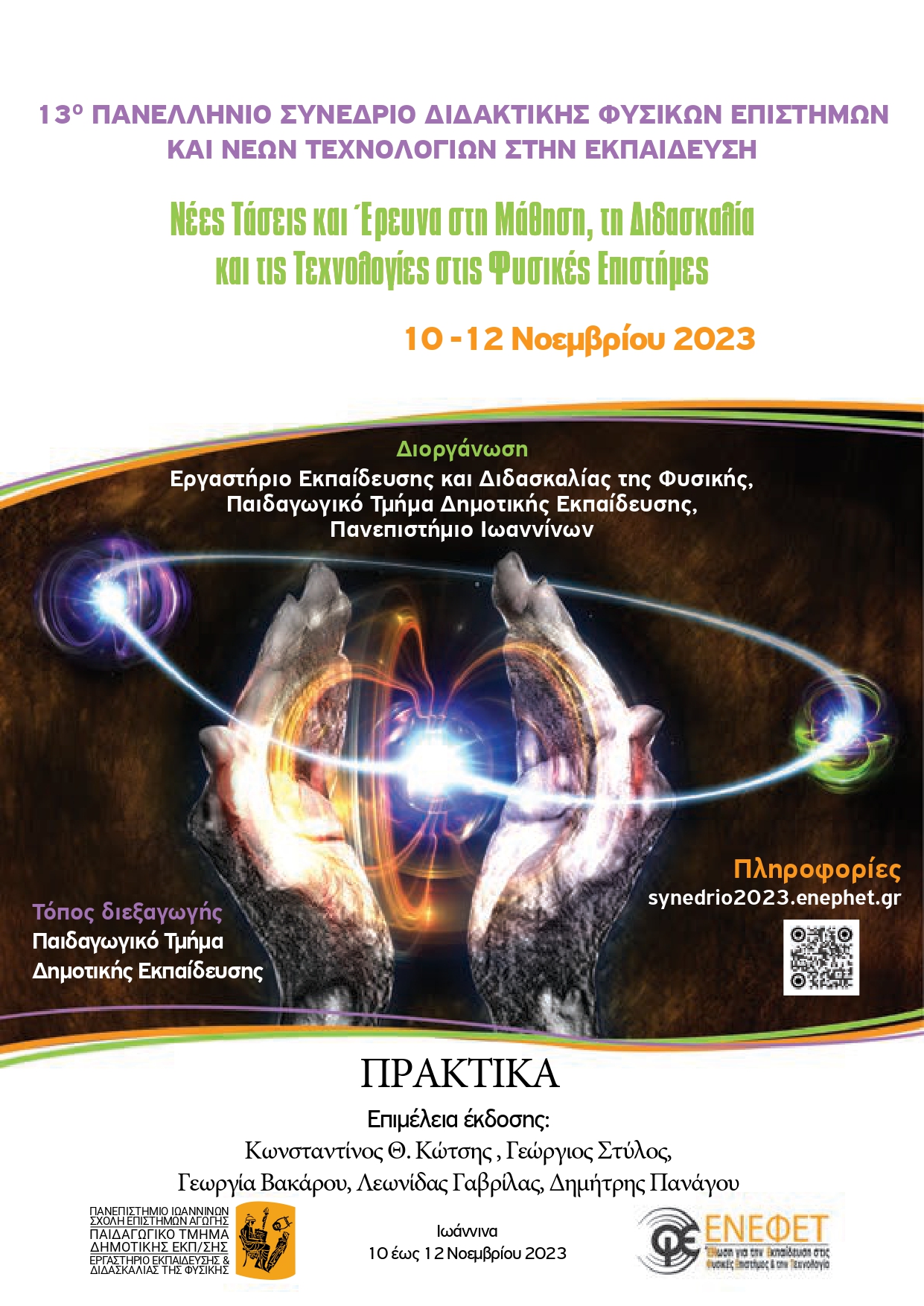
20 years of research in Greece for the didactics of Sciences through panhellenic conferences
Published:
Sep 12, 2024
Keywords:
Research in Greece ENEFET Didactics of Sciences Greek Conferences on Science Education
Abstract
ENEFET is the organisation that scientifically expresses research on teaching natural sciences and the application of technology in their education today. Every two years, a Panhellenic Conference is organised, presenting what new research has to offer in this field in Greece. EDIFE also operated in parallel with its conferences for a long time until the two associations were expressed through ENEFET. This paper presents various characteristics of the papers presented at conferences on the teaching of sciences from 2004 onwards.
Article Details
- Section
- ORAL PRESENTASIONS
Downloads
Download data is not yet available.
References
Αναλυτικό Πρόγραμμα του 1935 (Β.Δ. 5-11-1935, ΦΕΚ 537/τ. Α’)
Ζαφειροπούλου, Κ. (2012). Συγκριτική αξιολόγηση του ερευνητικού έργου των ελληνικών ομάδων διδακτικής των φυσικών επιστημών (Διπλωματική εργασία). Τμήμα Επιστημών της Εκπαίδευσης και της Αγωγής στην Προσχολική Ηλικία, Πανεπιστήμιο Πατρών, http://hdl.handle.net/10889/5784
Ζημιανίτης Π. (2020). Η σύγχρονη έρευνα στη διδακτική της φυσικής στην Ελλάδα, Διατριβή Μεταπτυχιακής Έρευνας, Τμήμα Φυσικής Πανεπιστημίου Ιωαννίνων, http://dx.doi.org/10.26268/heal.uoi.9739
Κόκκοτας, Π. Β. (2001). Διδακτική των φυσικών επιστημών (4η αναθ. έκδ.). Αθήνα: Γρηγόρης.
Ραβάνης, Κ. (2003). Εισαγωγή στη διδακτική των φυσικών επιστημών. Αθήνα: Εκδόσεις Νέων Τεχνολογιών.
Τόμπρας Γ., Νισταζάκης Ε., Κώτσης Κ., Καλογιαννάκης Μ., Καλκάνης Γ.Θ. (2023). Τα νέα προγράμματα σπουδών Φυσικής / Φυσικών για το Λύκειο, το Γυμνάσιο και το Δημοτικό – Ζητούμενα και προσδοκίες, στο Κώτσης Κ.Θ. & κ.α. (επιμέλεια), Πρακτικά Συνόψεων, 13o Πανελλήνιο Συνέδριο της Διδακτικής των Φυσικών Επιστημών και Νέων Τεχνολογιών στην Εκπαίδευση. https://doi.org/10.12681/codiste.5568
Allmendinger, J. (1989). Educational systems and labor market outcomes. European sociological review, 5(3), 231-250. https://doi.org/10.1093/oxfordjournals.esr.a036524
Ausubel, D. P., Stager, M., & Gaite, A. J. H. (1968). Retroactive facilitation in meaningful verbal learning. Journal of Educational Psychology, 59(4), 250–255. https://doi.org/10.1037/h0025943
Driver, R., Newton, P., & Osborne, J. (2000). Establishing the norms of scientific argumentation in classrooms. Science Education, 84(3), 287-312. https://doi.org/10.1002/(SICI)1098-237X(200005)84:3<287::AID-SCE1>3.0.CO;2-A
Handelsman, J., Ebert-May, D., Beichner, R., Bruns, P., Chang, A., DeHaan, R., ... & Wood, W. B. (2004). Scientific teaching. Science, 304(5670), 521-522. https://doi.org/10.1126/science.1096022
Koleza, E., & Skordoulis, C. D. (2022). Innovating STEM Education: Increased Engagement and Best Practices. Champaign, IL: Common Ground Research Networks. http://dx.doi.org/10.18848/978-1-86335-251-2/CGP
Posner, M. I. (1982). Cumulative development of attentional theory. American Psychologist, 37(2), 168–179. https://doi.org/10.1037/0003-066X.37.2.168
Santos, L. F. (2017). The role of critical thinking in science education. Online Submission, 8(20), 160-173. https://eric.ed.gov/?id=ED575667
Van Driel, J. H., Beijaard, D., & Verloop, N. (2001). Professional development and reform in science education: The role of teachers' practical knowledge. Journal of Research in Science Teaching: The Official Journal of the National Association for Research in Science Teaching, 38(2), 137-158. https://doi.org/10.1002/1098-2736(200102)38:2<137::AID-TEA1001>3.0.CO;2-U
Ziman, J. M. (1980). Teaching and learning about science and society. Cambridge University Press.