Teaching Approach on Primary Mechanics Using Animated Interactive Video for Students with Autism Spectrum Disorder (level 1)
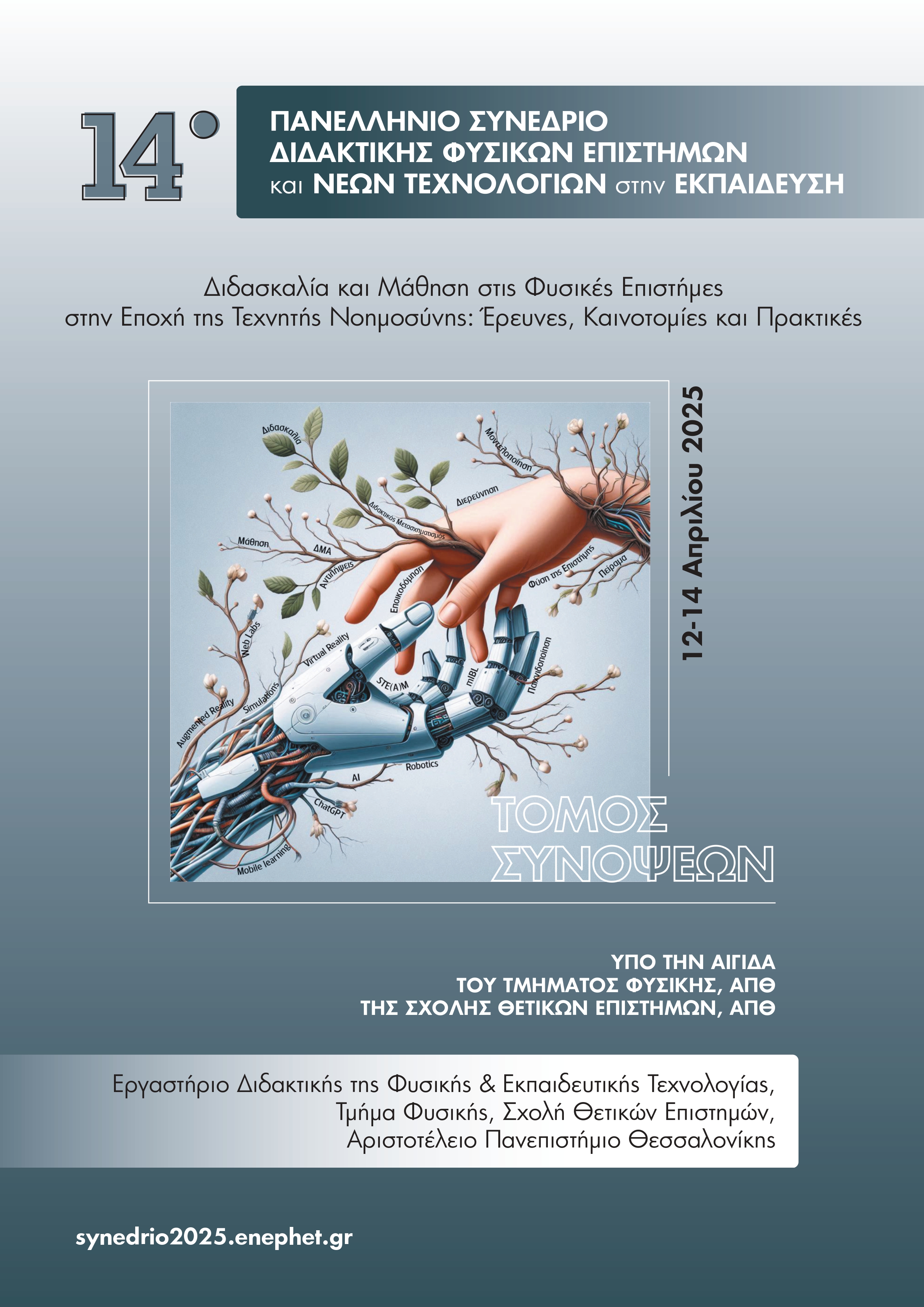

Published: Apr 3, 2025
Keywords:
Autism spectrum disorder, natural sciences, digital teaching tool, inclusive techniques
Antonios Karavasilis
Charilaos Tsihouridis
Nikolaos Mitrakas
Denis Vavougios
Abstract

The use of modern technology, focused in the field of natural sciences, becomes particularly interesting when addressed to students with Autism Spectrum Disorder through inclusively oriented educational activities. In this light, an educational digital software was designed, developed and implemented with the aim of teaching basic engineering concepts using cooperative models between students of typical development and students with ASD, 5th and 6th grade. The results of the research highlighted the positive contribution of the specific digital tool on the one hand to the more essential understanding of engineering concepts and on the other hand to the cultivation of the deficient social characteristics of the students of the home disorder.

Article Details
  • Section
  • 14th Panhellenic Conference of Didactics in Science Education
Downloads
Download data is not yet available.
References
Καραβασίλης, Α., & Τσιχουρίδης, Χ. (2022). Παιδιά με διαταραχή Αυτιστικού Φάσματος αλληλεπιδρούν με Serious Games και τα ταξινομούν. Συνέδρια της Ελληνικής Επιστημονικής Ένωσης Τεχνολογιών Πληροφορίας & Επικοινωνιών στην Εκπαίδευση, 0405-0418.
Akimkhanova, Z., Turekhanova, K., & Karwasz, G. P. (2023). Interactive games and plays in teaching physics and astronomy. Education Sciences, 13(4), 393.
Alvares, G. A., Bebbington, K., Cleary, D., Evans, K., Glasson, E. J., Maybery, M. T. & Whitehouse, A. J.: The misnomer of ‘high functioning autism’: Intelligence is an imprecise predictor of functional abilities at diagnosis. Autism, 24(1), 221-232 (2020).
Bravou, V., Oikonomidou, D., & Drigas, A. S. (2022). Applications of virtual reality for autism inclusion. A review. Retos: nuevas tendencias en educación física, deporte y recreación, (45), 779-785.
Chiang, T. H., Yang, S. J., & Hwang, G. J. (2014). Students' online interactive patterns in augmented reality-based inquiry activities. Computers & Education, 78, 97-108.
Karavasilis, A., Tsihouridis, C., Batsila, M., & Vavougios, D. (2022, September). A serious game as an educational tool to teach physics to high functioning autism students. In International Conference on Interactive Collaborative Learning (pp. 865-876). Cham: Springer International Publishing. https://doi.org/10.1007/978-3-031-26876-2_82
Mayer, R. E. (2014). Principles based on social cues in multimedia learning: Personalization, voice, image, and embodiment principles. The Cambridge handbook of multimedia learning, 16, 345-370.
Tsihouridis, C., Karavasilis, A., Batsila, M., & Vavougios, D. (2023, September). “Little Professors’” Cognitive Transformation Through Activity Triangles on Mechanics. In International Conference on Interactive Collaborative Learning(pp. 47-56). Cham: Springer Nature Switzerland. https://doi.org/10.1007/978-3-031-53382-2_5
Van Eylen, L., Boets, B., Steyaert, J., Wagemans, J., & Noens, I. (2015). Executive functioning in autism spectrum disorders: Influence of task and sample characteristics and relation to symptom severity. European Child & Adolescent Psychiatry, 24, 1399-1417. https://doi.org/10.1007/s00787-015-0689-1