Τεχνητή Νοημοσύνη και Γεωγραφία: Προκλήσεις και Νέες Ευκαιρίες στη Διδασκαλία και Μάθηση
Δημοσιευμένα:
Apr 6, 2025
Λέξεις-κλειδιά:
Γεωγραφική Εκπαίδευση Διδασκαλία και μαθηση στη Γεωγραφία Τεχνητή Νοημοσύνη
Περίληψη
Αυτή η εργασία διερευνά τις δυνατότητες και τις προκλήσεις της ενσωμάτωσης της Τεχνητής Νοημοσύνης (Artificial Intelligence-AI) στη γεωγραφική εκπαίδευση, αναδεικνύοντας τα οφέλη της, όπως η διαδραστική οπτικοποίηση και η εξατομικευμένη μάθηση. Εξετάζει το ρόλο της AI στην αντιμετώπιση παγκόσμιων προκλήσεων όπως η κλιματική αλλαγή, επισημαίνοντας τη σημασία της δίκαιης πρόσβασης στην τεχνολογία και της εκπαίδευσης των εκπαιδευτικών. Η μεθοδολογία περιλαμβάνει αφηγηματική βιβλιογραφική ανασκόπηση, αναλύοντας δεδομένα σχετικά με την εφαρμογή της Τεχνητής Νοημοσύνης στη διδασκαλία και μάθηση της γεωγραφίας. Επιπλέον, η εργασία υπογραμμίζει τις ευκαιρίες που προσφέρει η AI στην εκπαίδευση και τις προκλήσεις που πρέπει να αντιμετωπιστούν.
Λεπτομέρειες άρθρου
- Ενότητα
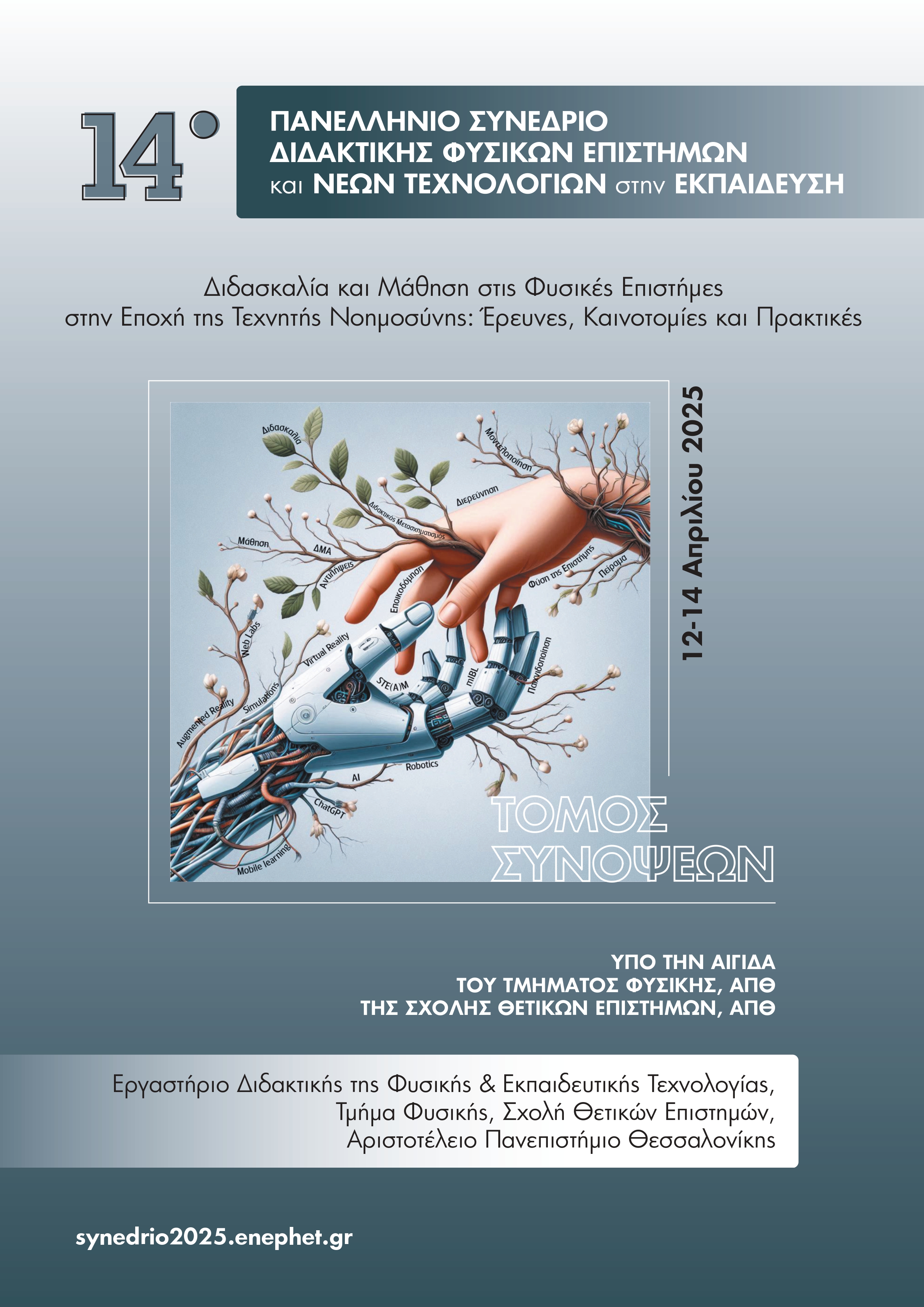
- 14o Συνέδριο Διδακτικής Φυσικών Επιστημών και Νέων Τεχνολογιών στην Εκπαίδευση
Λήψεις
Τα δεδομένα λήψης δεν είναι ακόμη διαθέσιμα.
Αναφορές
Albahbah, M., Kıvrak, S., & Arslan, G. (2021). Application areas of augmented reality and virtual reality in construction project management: A scoping review. Journal of Construction Engineering, Management & Innovation, 4(3). https://doi.org/10.31462/jcemi.2021.03151172
Chang, C.-H., & Kidman, G. (2023). The rise of generative artificial intelligence (AI) language models - challenges and opportunities for geographical and environmental education. International Research in Geographical and Environmental Education, 32(2), 85–89. https://doi.org/10.1080/10382046.2023.2194036
Chen, M., Claramunt, C., Çöltekin, A., Liu, X., Peng, P., Robinson, A. C., Wang, D., Strobl, J., Wilson, J. P., Batty, M., Kwan, M.-P., Lotfian, M., Golay, F., Joost, S., Ingensand, J., Senousi, A. M., Cheng, T., Bandrova, T., Konecny, M., … Lü, G. (2023). Artificial intelligence and visual analytics in geographical space and cyberspace: Research opportunities and challenges. Earth-Science Reviews, 241, 104438. https://doi.org/10.1016/j.earscirev.2023.104438
Chorley, R. J. (Ed.). (2019). Directions in Geography. Routledge. https://doi.org/10.4324/9780429273292
Cope, B., Kalantzis, M., & Searsmith, D. (2021). Artificial intelligence for education: Knowledge and its assessment in AI-enabled learning ecologies. Educational Philosophy and Theory, 53(12), 1229–1245. https://doi.org/10.1080/00131857.2020.1728732
Guan, C., Mou, J., & Jiang, Z. (2020). Artificial intelligence innovation in education: A twenty-year data-driven historical analysis. International Journal of Innovation Studies, 4(4), 134–147. https://doi.org/10.1016/j.ijis.2020.09.001
Huang, J., Saleh, S., & Liu, Y. (2021). A Review on Artificial Intelligence in Education. Academic Journal of Interdisciplinary Studies, 10(3), 206. https://doi.org/10.36941/ajis-2021-0077
Janowicz, K., Gao, S., McKenzie, G., Hu, Y., & Bhaduri, B. (2019). GeoAI: spatially explicit artificial intelligence techniques for geographic knowledge discovery and beyond. International Journal of Geographical Information Science, 34(4), 625–636. https://doi.org/10.1080/13658816.2019.1684500
Kamrowska-Załuska, D. (2021). Impact of AI-Based Tools and Urban Big Data Analytics on the Design and Planning of Cities. Land, 10, 1209. https://doi.org/10.3390/land10111209
Knox, J. (2020). Artificial intelligence and education in China. Learning, Media and Technology, 45(3), 298–311. https://doi.org/10.1080/17439884.2020.175423
Lavallin, A., & Downs, J. A. (2021). Machine learning in geography–Past, present, and future. Geography Compass, 15(5). https://doi.org/10.1111/gec3.12563
Li, W., & Hsu, C.-Y. (2022). GeoAI for Large-Scale Image Analysis and Machine Vision: Recent Progress of Artificial Intelligence in Geography. ISPRS International Journal of Geo-Information, 11(7), 385. https://doi.org/10.3390/ijgi11070385
Papanastasiou, G., Drigas, A., Skianis, C., Lytras, M., & Papanastasiou, E. (2019). Virtual and augmented reality effects on K-12, higher and tertiary education students’ twenty-first century skills. Virtual Reality, 23(4), 425–436. https://doi.org/10.1007/s10055-018-0363-2
Tripathi, P., Saxena, P. (2024). An Assessment of the Role of Artificial Intelligence on Sustainable Development Goals. In: Sannikova, L.V. (eds) Digital Technologies and Distributed Registries for Sustainable Development. Law, Governance and Technology Series, 64 (pp.3-23). Springer, Cham. https://doi.org/10.1007/978-3-031-51067-0_1
Zawacki-Richter, O., Marín, V. I., Bond, M., & Gouverneur, F. (2019). Systematic review of research on artificial intelligence applications in higher education – where are the educators? International Journal of Educational Technology in Higher Education, 16(1), 39. https://doi.org/10.1186/s41239-019-0171-0