The MONUBASIN symposium addresses research by restoration engineers, architects, geologists, restorers and conservators of stone artefacts, as well as other specialists in the decay and restoration of monuments, and by archaeologists, art historians, and scientists in the fields of physics, chemistry, biology, and computer and information science.
Current Issue
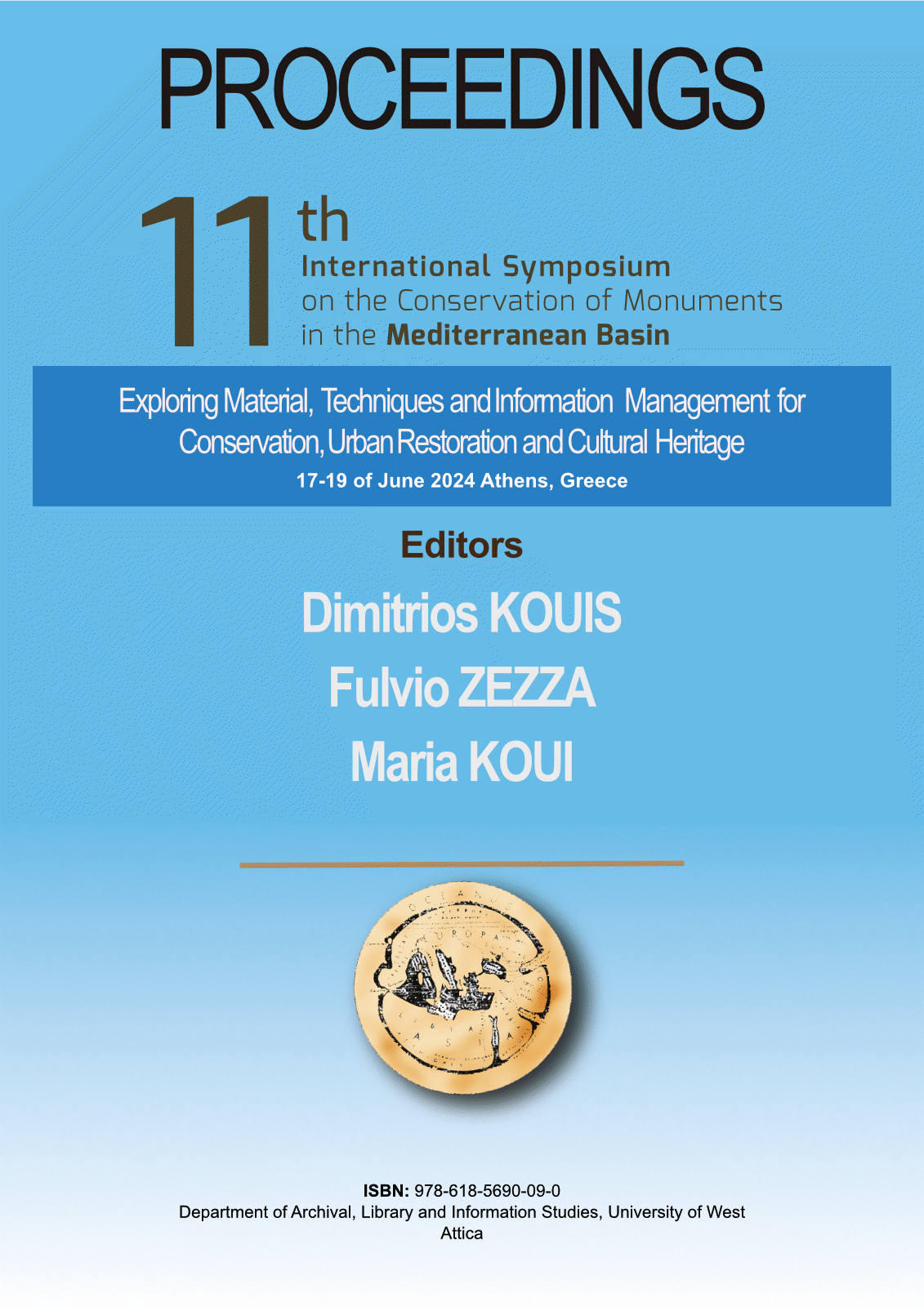
Proceedings of the 11th MONUBASIN (2024)
Published: 2026-02-17
The theme of the 11th MONUBASIN is “Exploring Material, Techniques and Information Management for Conservation, Urban Restoration and Cultural Heritage,” and refers to materials and techniques, as well as to technologies used for damage assessment, rehabilitation, and restoration in urban environments, in the direction of sustainable and long-lasting conservation. The thematology of the MONUBASIN Symposium also includes aspects of Information Management related to conservation/restoration procedures and techniques (e.g., recording, documentation, protection, and monitoring tasks), as well as the overall management of both research and cultural heritage data.
11th International Symposium on the Conservation of Monuments in the Mediterranean Basin, 17-19 June 2024, Athens, Greece
Full Issue
Part I – Opening Speeches
Part II - Historical and Structural Aspects of Monuments
Preliminary Restoration Proposal for the Holy Monastery of “Kokkini Ecclesia” (Red Church) in Lefkada
Apostolos Linos Apostolopoulos, Alkiviadis Apostolopoulos, Charis Apostolopoulos, Dimitris Diamantakos, Nikolaos Kaldis
Characterization and origin of ancient metallurgical slags from the ancient settlement of Archampolis, Euboea Island, Greece
Antonios Kontorozis, Michael Stamatakis, Eleftheria Dimou
Characterization of mortars from the Vartalis Watermill in Cyprus
Ioanna Panteli, Ioannis Ioannou, Ioannis Rigopoulos, Margarita L. Petrou
The Vasari Corridor of the Uffizi in Florence New monitoring systems for sustainable restoration
Susanna Caccia Gherardini
Investigating color on Archaic architecture: “Athena” from the Gigantomachy pediment of the Temple of Apollo at Delphi
Giasemi Frantzi, Sotiria Kogou, George Mastrotheodoros, Athanasia Psalti, Panayiotis Theoulakis, Harikleia Brekoulaki
Part III - Digital Techniques and Information Management for Cultural Heritage
Contribution of 3D Bedrock Formation to the Restoration of the Ancient Theater of Dodoni, Greece
Dimitrios Makris, Petros Katsoudas
Rope access monitoring and data management of the monumental complex in Piazza dei Miracoli in Pisa
Sara Chirico, Chiara Di Marco, Ada Rovazzani, Roberto Cela
Innovative applications of 3D printed elastomers in the restoration of Cultural Heritage
Alberta Paglione, Carla Giovannone, Angelo Raffaele Rubino, Claudio Santangelo, Francesco Frullini, Angelandreina Rorro, Ludovica Ruggiero, Roberto Ciabattoni
Using wikidata for managing cultural heritage information
Daphne Kyriaki Manessi, Styliani Vazaiou
Phygital Heritage Experiences in Refugee Attica
Angeliki Antoniou, Despoina Lampada, Afroditi Kamara, Daphne Kyriaki-Manessi
Beyond the Standards: Combine Different Metadata Schemas for a Versatile Museum Repository Development
Kostas Maistrelis, Thanos Kyritsis, Simos Leonidakos, Evangelia Papadaki, Pantelis Brattis, Nikos Papazis
Part IV - Methodologies for Characterization and Damage Assessment
Investigation of post-restoration salt weathering at the mosaics of Dafni Monastery, Greece
Ekaterini Ftikou, Petros Prokos, Alexis Stefanis
Evaluation of salt weathering in stone using a new test procedure: a comparative laboratory study
Loucas Kyriakou, Ioannis Ioannou, Magdalini Theodoridou, Derrick Mwebaza
Non-invasive pigment identification of post-Byzantine wall paintings from 11th century Monastery of Daphne in Athens (Greece)
Vasiliki Dritsa, Alexandros Stouraitis, Ekaterini Ftikou, Maria Koui
The application of non-destructive imaging techniques for the study and revelation of sketches under the whitewash layers of the interior walls of the House-Museum of Giannoulis Halepas, in Tinos Island, Greece
Agathi Anthoula Kaminari, Nikolaos Alexios Stefanis, Maria Chatzidaki, Despoina Fasouli, Athina Georgia Alexopoulou
Νon-invasive pigments identification in Macedonian Tomb of Hellenistic period
Vasiliki Dritsa, Konstantinos Mantelos, Maria Koui, Ekaterini Ftikou
Creating a dataset of digital images of Byzantine frescoes for analysis and classification using machine learning techniques
Antigoni Vlisidi, Antonia Moropoulou
Simulation-aided infrared thermography with a new efficient channel attention mechanism aided Faster R-CNN model and decomposition-based noise reduction for detecting defects in ancient polyptychs
Xin Wang, Guimin Jiang, Miranda Mostacci, Stefano Sfarra, Hai Zhang
The database of notarial bindings- a tool for the study of historical binding structures and their condition
Angeliki Stassinou, Konstantinos Choulis, Athena-Georgia Alexopoulou, Ioannis Kokkonas, Markos Dendrinos, Yannis Stoyannidis
Numerical evaluation of thermal load applied by magnetic induction and solar loading aimed at experimental analyses using thermo-graphic techniques
Stefano Perilli, Yinuo Ding, Hai Zhang, Stefano Sfarra
Study of Indoor Air Quality Impact During Building Demolition: A Case Study of the 2009 L’Aquila Earthquake Reconstruction
Wei-Shiang Lin, Stefano Sfarra, Yuan Yao
Materials characterisation and damage assessment of the ancient kiln of Kirra, Greece
Nikolaos-Alexios Stefanis, Panagiotis Theoulakis, Dimitrios Makris, Anna Koukouli, Aristophanis Konstantatos
Part V - Natural and Anthropogenic Damage Hazards
The conservation plan for Morosini fountain: an opportunity for reflection and redefinition of the norms
Maria Deli, Maria Mertzani
Revisiting the Mosaic of the Masks on Delos: A Comprehensive Condition Survey
Christos Maris, Styliani Minetou, Ioannis P. Staikopoulos, Stefania Chlouveraki
Ancient Sanctuary at Kalapodi, Fthiotis, central Greece. Presentation of Restoration Works and the implementation of Triquetra Programme.
Dr. Themistoklis Bilis, Angelos Sotiropoulos
Monitoring the Effects of Climate Change on Microclimate and Building Materials of Monuments – the approach of “Herisktage” Research Project
Theocharis Katrakazis, Vicki Kontogianni, Eirini Tziviloglou, Vassilis Kilikoglou, Ioannis Karatasios, Athanasios Sfetsos, Diamando Vlachogiannis, Iason Markantonis, Maria Mertzani, Petros Prokos, Ekaterini Ftikou
Part VI - Decorative Architecture Design, Planning and Cultural Heritage Management
Tears in the Rain. Street Art Conservation in a City that is Constantly Changing
Maria Chatzidakis, Alexis Stefanis
Part VII - Technologies for Damage Rehabilitation and Sustainable Preservation
The Open Lab. Empowering Community Engagement and Knowledge in Conservation and Treatment Methods
Panagiota Andrianopoulou, Eleni Papathoma, Dimitrios Kouis, Ioannis Drivas
Protection coatings for stone monuments and artefacts of cultural heritage made of calcitic materials
Panagiota D. Natsi, Andreas Tzachristas, Varvara Sygouni, Christakis A. Paraskeva, Petros G. Koutsoukos
Resilient and adaptive renovation of 20th century buildings towards net-zero carbon built heritage – The approach of the SINCERE re-search project
Eirini Tziviloglou, Christos Stentoumis, José Ignacio Alvarez, Evangelos Stathopoulos, Sotiris Diplaris, Athanasios Sfetsos, Diamando Vlachogiannis, Ioannis Karatasios
Restoration of rising damp in the Sassi of Matera through the use of innovative technologies
Graziella Bernardo, Cristina Rinaldi, Antonella Guida
Optimizing the In Situ Deposition of Carbonate Hydroxyapatite for the Consolidation of Marble in Cultural Heritage Monuments
Anna Filopoulou, Stamatis C. Boyatzis, Alexios Stefanis, Maria Giannoulaki
Multifunctional composite coatings consisting of polymers and zinc oxide nanoparticles for the protection of stone heritage
Ioannis Karapanagiotis, Panagiotis Manoudis, Ioannis Zuburtikudis, Hadil Abu Khalifeh
Hydrophobization of limestone using fluorinated and TEOS-based polymers
Styliani Katsikoglou, Dimitra Aslanidou, Ioannis Karapanagiotis