Simulation-aided infrared thermography with a new efficient channel attention mechanism aided Faster R-CNN model and decomposition-based noise reduction for detecting defects in ancient polyptychs
Abstract
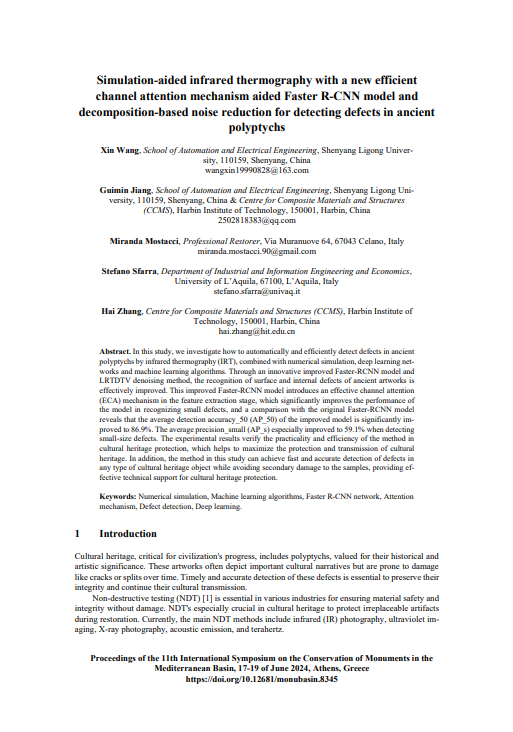
In this study, we investigate how to automatically and efficiently detect defects in ancient polyptychs by infrared thermography (IRT), combined with numerical simulation, deep learning networks and machine learning algorithms. Through an innovative improved Faster-RCNN model and LRTDTV denoising method, the recognition of surface and internal defects of ancient artworks is effectively improved. This improved Faster-RCNN model introduces an effective channel attention (ECA) mechanism in the feature extraction stage, which significantly improves the performance of the model in recognizing small defects, and a comparison with the original Faster-RCNN model reveals that the average detection accuracy_50 (AP_50) of the improved model is significantly improved to 86.9%. The average precision_small (AP_s) especially improved to 59.1% when detecting small-size defects. The experimental results verify the practicality and efficiency of the method in cultural heritage protection, which helps to maximize the protection and transmission of cultural heritage. In addition, the method in this study can achieve fast and accurate detection of defects in any type of cultural heritage object while avoiding secondary damage to the samples, providing effective technical support for cultural heritage protection.
Article Details
- How to Cite
-
Wang, X., Jiang, G., Mostacci, M., Sfarra, S., & Zhang, H. (2024). Simulation-aided infrared thermography with a new efficient channel attention mechanism aided Faster R-CNN model and decomposition-based noise reduction for detecting defects in ancient polyptychs . International Symposium on the Conservation of Monuments in the Mediterranean Basin, 183–189. https://doi.org/10.12681/monubasin.8345
- Section
- Part IV - Methodologies for Characterization and Damage Assessment
You are free to:
- Share — copy and redistribute the material in any medium or format
- The licensor cannot revoke these freedoms as long as you follow the license terms.
Under the following terms:
- Attribution — You must give appropriate credit, provide a link to the license, and indicate if changes were made. You may do so in any reasonable manner, but not in any way that suggests the licensor endorses you or your use.
- NonCommercial — You may not use the material for commercial purposes.
- NoDerivatives — If you remix, transform, or build upon the material, you may not distribute the modified material.
- No additional restrictions — You may not apply legal terms or technological measures that legally restrict others from doing anything the license permits.