Performing Space is an ambitious project that aims to explore the relationship between performance and the built environment from all disciplines that study human activity.
The main objective of Performing Space is to create a meeting point where studies from different disciplines can be presented, experimented with and discussed. The Performing Space 2023 Conference and Workshop, held in Nafplio, Greece, from 7 to 14 July 2023, was the second edition of this project. It was co-organised and hosted by the University of the Peloponnese, supported by the Polytechnic University of Madrid and featured 36 papers and 12 workshop participants from 10 different countries.
The results of Performing Space 2023 presented in this publication show some of the main lines of work currently being carried out. A large number of presentations show the performative expression of space through site-specific performances, a recurring line of work since the origins of the artistic expression called Happenings or, later, Performance art. There is also a large number of papers exploring, from different angles, the relationship between space, ritual and myth, a very interesting approach to the built environment that has been recurrent since the 19th century in archaeology, anthropology, geography and sociology, but which is here extended to theatre studies and cognitive sciences. Different philosophical approaches to the scenic space were also presented and we hope that in future editions, within the always necessary philosophical approach, more works on the built environment will be presented. Another interesting approach is represented by the works of different disciplines that use performance as a tool to understand our environment, of which we had several presentations in this edition. One approach that could not be overlooked is the digital, a medium that is becoming increasingly present in our perception of the environment. In this issue, several papers reflected on the use of the digital image in different types of performance. Finally, several papers were presented on the use of performance in education, an increasingly important issue that needs to be addressed in order to counteract the harmful effects of digital media.
Current Issue
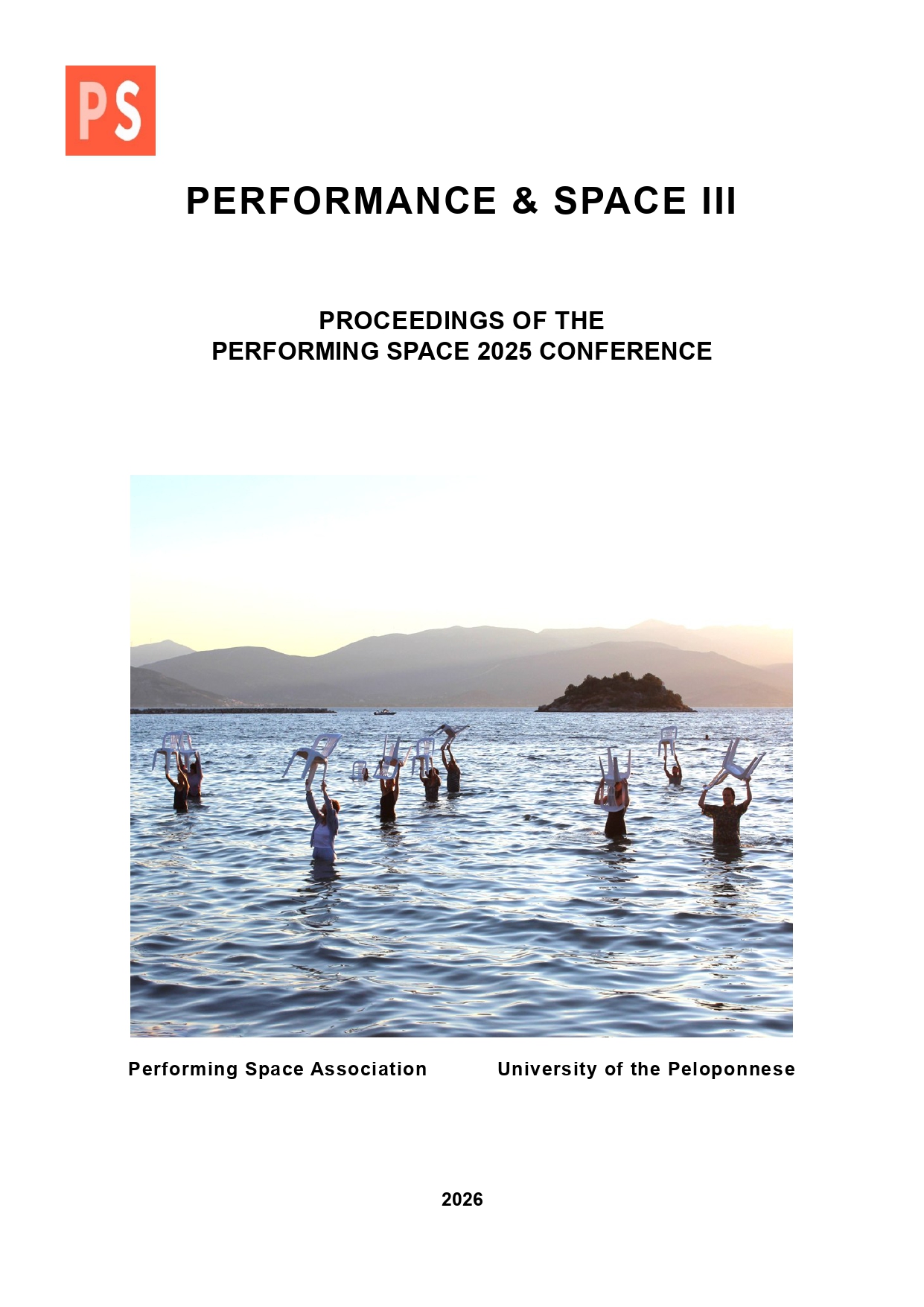
2026: PERFORMANCE & SPACE III. PROCEEDINGS OF THE PERFORMING SPACE 2025 CONFERENCE
Published: 2026-04-19
Performing Space is a research project that explores the relationship between performance and the built environment, taking into account the different perspectives of disciplines that study human activity and space, such as anthropology, archaeology, architecture, cognitive sciences, economics, geography, law, performance studies, philosophy, sociology, and theatre studies. The project understands ‘performance’ as “all activity of a given participant on a given occasion which serves to influence in any way any of the other participants” (Goffman, 1956, pp. 8–9). Following this definition, any activity that people carry out with the conscious or (usually) unconscious intention of influencing their social and spatial environment can be considered a form of performance. Catherine Bell (1992) and other authors argue that our performances influence our environment by transforming it; at the same time, the environment influences our behaviours and mental states. The title of this project, Performing Space, refers to this circular process of environmental transformation through our performances and the reciprocal influence of the environment on those performances, as well as to the space in which performances take place: the built environment.
The primary objective of Performing Space has been to establish a platform for presenting, experimenting with and debating research from different disciplines on performance and its environment. In other words, the project aims to foster an international network dedicated to discussing and disseminating the performative understanding of space, which is essential for both interpreting and shaping our environment. To this end, the project has been developed through international conferences that include academic and artistic research presentations, alongside workshops designed to experiment with methodologies that explore the relationship between space and performance. Since its first edition in Nafplio, Greece, in 2022, Performing Space has steadily grown as a collaborative and interdisciplinary community.
Full Issue
Articles
Reading the City: The Performative Function of Text and the Dramaturgy of Public Space
Georgia Kanellopoulou
The Body as Deus Ex Machina: Revealing the Stage through Apparatus
Gülten Nur Bilgiç, Pelin Dursun Çebi
Mapping Temporal and Spatial Dynamics of Imperial Rituals in the Forbidden City
Wen Liang, Xiao Yang, Rebeca Zhu Cao
Staging Resistance: The Girl of Enghelab Street and the Theatricality of Public Space in Iran
Sara Gholami, Sara Boroumandi Barati
Lipstick Liberation
A feminist performance mapping the femicides in the public performing space
Marianna Koukoulekidou , Angeliki Maria Ntoufa
Urban Vampire: A Rite of Passage
A threshold experience of a performative paper
Arianna Chatzigalanou
Devising Experiments with Interactive Environments
Pavlos Panagiotidis, Jocelyn Spence, Nils Jäger
Deciphering Mechanisms and Narration Systems in the Natural Landscape: The Case of Keros
Valassia Barbouti, Myrto Andronidi
Where do I Play my Body?
A Round Trip Between Virtual Stages and Real-World Arenas
Alessandro Di Egidio
PERFORMANCE & SPACE III. PROCEEDINGS OF THE PERFORMING SPACE 2025 CONFERENCE
Pablo Berzal Cruz, Athena Stourna, Tyrone Grima, Philip Hager, Alba Balmaseda Domínguez, Greig Burgoyne